
Our research group engages in human geography research, broadly defined.
As a collective, we support the Human Geography Lab (Room 2.11 of 221 Bouverie Street), a place for thinking, collaborating and training in qualitative, creative, performative and post-qualitative research methodologies.
Book the lab
To book the lab for group use (e.g. weekly, monthly), click the button below.
To use one of the two desktop iMacs, the space is open for walk-in/communal use (see Human Geography Lab coordinator if you have not yet been provided with the key safe code).
*If the entire space is already in use by a group, that time is not available for desktop use.
Hire equipment
All equipment hire requests must be submitted via the equipment booking form below.
Additional information may be required if:
- A loan period exceeds 3 weeks,
- The equipment will be transported interstate or overseas, or
- The intended location of use is considered high risk.
Human Geography Lab User Guide
The Human Geography Lab is home to a comprehensive range of video and audio recording equipment, as well as two Apple iMacs with the necessary software for editing, audio transcription, and qualitative coding.
This User Guide is designed to introduce you to the Lab’s key procedures, personnel, and equipment. It also includes the necessary links for room and equipment bookings.
Contact
For enquiries or the key safe code, please email Human Geography Lab coordinator Dr Elisabetta Crovara - e.crovara@unimelb.edu.au
Meet the academics and researchers in the Human Geography Lab.
Academic staff
Dr Miles Kenney-Lazar
Dr Sergio Jarillo de la Torre
Graduate researchers
Thu Le
Kate Douglas
Bridie Shepherd
Tammie Wong
Bin Wang
Research projects
SGEAS Podcast
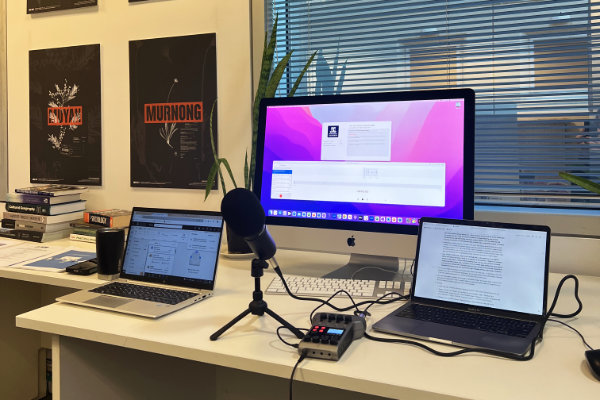
Podcasts are a useful form of audio media for sharing easily summarised snippets of the research we do as a community. Right now, SGEAS is starting to produce our first all-of-School podcast. Based in the HG Lab, this program offers up a regular SGEAS podcast to interview guests from within and outside of the School about their field of research. Guests on the podcast offer a short summary of the work they do, then dive into their wider field of interest, offering listeners an overview of the many rich fields of research with which we engage.
The Lab is the perfect space for hosting this kind of project. It has soundproofing, computer power, and the technology needed to record and edit audio. In the past, tutors and subject coordinators have used the Lab to create audio-guided walking tours for students on Melbourne's waterways and urban lives. Thanks to a recent grant from SGEAS Engagement Committee, the Lab now has the equipment to record podcasts. In future, look out for podcasting training sessions and opportunities at the Lab to sharpen your audio skills!
Filmmaking in research and teaching
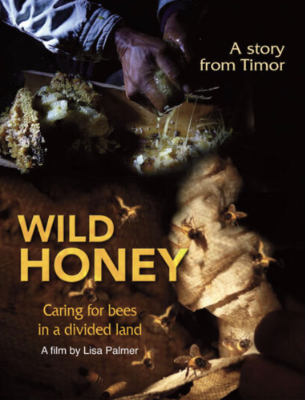
In 2021, a consortium of creative-methods human geographers won a Faculty of Science equipment grant to support research, filmmaking and teaching with filmmaking in SGEAS. With this grant, they purchased a film camera and other audiovisual recording equipment, as well as Final Cut Pro software. Many current members of the HGL engage in filmmaking as part of their research. Professor Lisa Palmer has, for example, filmed many films in Timor-Leste using the Lab’s camera, including one about caring for wild bees.
Filmmaker Bridie Shepherd, a Graduate Researcher in SGEAS, is currently developing a tutorial for first-time users of the camera.
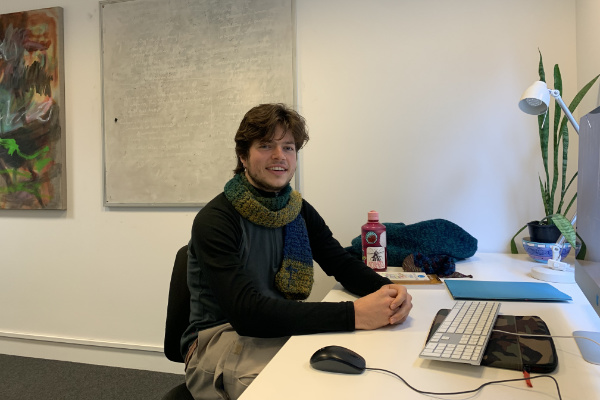
Like a hermit crab, my new shell has been found… the Human Geography Lab.
In commencing my Honours year - researching gathering at an Aboriginal Gathering Place - I was looking for a place to undertake this mammoth task… searching for somewhere away from the hustle and bustle of university life. The Baillieu library was too crowded, and the Honours room was too dark and bleak. My supervisor alerted me to the existence of the Human Geography Lab and once I visited, I knew it was the one - the perfect shell!
The space has borne witness to an uncountable number of words, ideas and pages which I have had to consume to develop my theoretical toolkit. The whiteboard to mind map after mind map, becoming more and more nuanced with time. The desk to the tapping of pens, interspersed with moments of inspiration and frantic writing. The windows have held my gaze, letting my mind wander and clutch at concepts that feel irredeemably far away from one another.
Overall, the space has been the perfect home (read shell) for my thesis production process, and I hope this human (read crab) can continue to prosper in the lab.