GEOG30025 Biogeography & Ecology of Fire/GEOG90027 Biogeography and Ecology of Fire PG
Teaching Week Field Trip Held: Pre-semester (January/February)
Handbook Entry: GEOG30025 / GEOG90027
Field Trip Coordinator: Michael-Shawn Fletcher
Register
The aim of this subject is to understand how terrestrial systems have evolved to cope with and exploit fire, and to place the extreme flammability Australia’s vegetation within a global context. The subject will examine concepts such as resilience, positive feedback loops, hysteresis and alternative stable states. The use of fire by humans to manipulate environments will be examined, with a particular emphasis on the variety of approaches employed by people across a diversity of environments over long periods of time, allowing an exploration of the social and cultural dynamics of fire and environmental management.

Some highlights or typical activities of the Field Trip
- Deep lake sediment coring
- Tree coring
- Vegetation surveys
- Mammal surveys
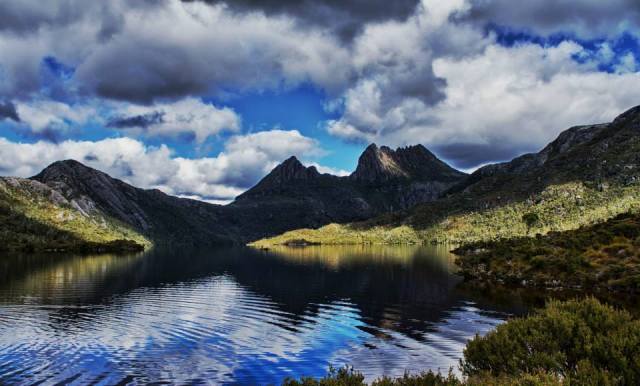
- Sightseeing around Cradle Mountain in Tasmania
- Sitting around an open fire every night
The 7-day field trip takes place in and around Cradle Mountain in Tasmania. We spend time learning about and developing hypotheses to explain the paradoxical vegetation landscape in this area. We then design a field sampling experiment to be conducted over the four days. We will all have a full day of sightseeing and field learning around the spectacular Cradle Mountain glacial valley. Students will partake in a wide range of biogeographical fieldwork types: deep lake sediment coring from a floating platform, tree coring (dendroecology), soil sampling, vegetation surveying, mammal surveys. The collected samples will then be analysed in the palaeoecology laboratory at the University of Melbourne. Make no mistake, in this subject, you will be working in amazing landscape and doing real science!