Teaching Week Field Trip Held: January - February 2017
Field Trip Coordinator: Lesley Head
Register
It provides opportunities for students to pursue focused field programs that examine critical issues such as urban development, regional sustainability, cultural and landscape heritage preservation, tourism and biodiversity management from interdisciplinary perspectives.
Two field programs are on offer during the Summer period in January-February 2017. Each program involves 3 weeks of intensive study in Mpumalanga, a stunningly beautiful province of South Africa. In the local SiSwati language, Mpumalanga means ‘the place where the sun rises’. It is a place of rich biological and cultural diversity and economic activity that links Johannesburg – Africa’s powerhouse – with Mozambique and the Indian Ocean Region.
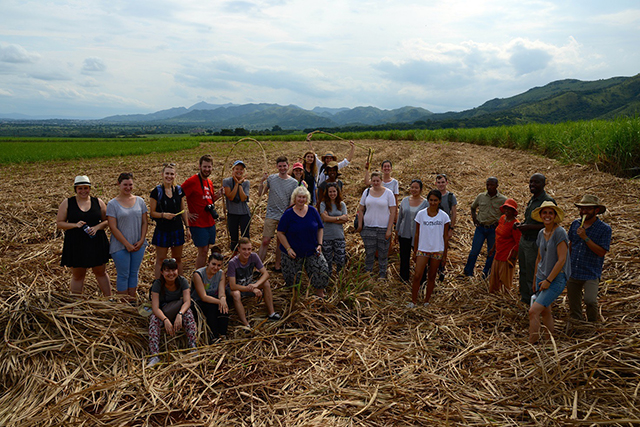
Regional Sustainability - 17 January to 5 February 2017
The intensive study program takes place in the unique lowveld area of the province bordered by the Kruger National Park, Swaziland, and Mozambique. You will learn about all the issues and challenges faced by provincial and local government agencies, community organisations, businesses and conservation groups in tackling matters such as land and water rights, agricultural development, gender, health, education, public transportation and environmental protection. You will work with them to identify strategies and projects for sustainable regional development.
Cultural Heritage and Landscape Management – 6 February to 24 February 2017
The intensive study program takes place in the Drakensberg escarpment, the heart of southern Africa’s archaeological and ancient history. This breathtaking landscape was the crucible of the Bokoni civilisation that extended agriculture and trade routes to the Indian Ocean. You will learn about the histories of African civilisations in the Drakensberg Escarpment, the stone walled settlements and agricultural terraces and landscapes of the Bakoni people, the impacts of European settler expansion, and the contemporary effects of mining and urban development on heritage sites. You will work with local researchers and community groups to identify feasible projects and enterprises that effectively conserve and manage Bokoni cultural heritage and landscapes.
Some highlights or typical activities of the Field Trip
- Visit farms and community development projects
- Discussions with local academics, communities, businesses, environmental managers, government agency officials and NGO representatives
- Examine impacts of large-scale projects and economic corridor linkages via Mozambique to the Indian Ocean
- Identify feasible projects and enterprises that promote sustainable regional development
- Visit archaeological sites and community heritage projects
- Examine impacts of ongoing and new mining projects on cultural heritage sites