UoM Luminescence Dating Facility
Quaternary Landscapes and Sediment (QuaLaS)
What is luminescence dating?
Luminescence dating is a widely used geochronological method that allows archaeologists and geoscientists to determine the timing of past events. It estimates when sediments were last exposed to sunlight or heat. Optically stimulated luminescence (OSL) dating is commonly applied to determine the timing of sediment deposition. The method is effective over a broad timescale, ranging from a few decades to several tens or even hundreds of thousands of years.
The Luminescence Dating Facility at UoM, managed by A/Prof Jan-Hendrik May, has several decades of experience in dating a wide range of sediments and rocks from diverse landscapes and settings.
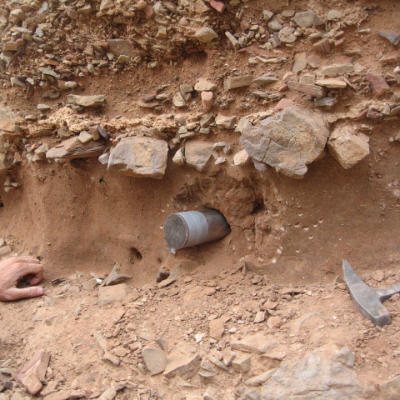
Projects
Recently completed or ongoing collaborative projects include:
- Dating beach / ice-push ridges in Antarctica (with Monash University)
- Singe-grain and rock surface dating in the Plain of Jars, Laos (with Dr Louise Shewan, SGEAS)
- Developing luminescence methods to date quartz in the Pilbara (with UNSW Canberra)
- Reconstructing fluvial-aeolian interaction in the Mallee (with Monash University)
- Dating neotectonic fault activity in Queensland (with Prof Mark Quigley, SGEAS)
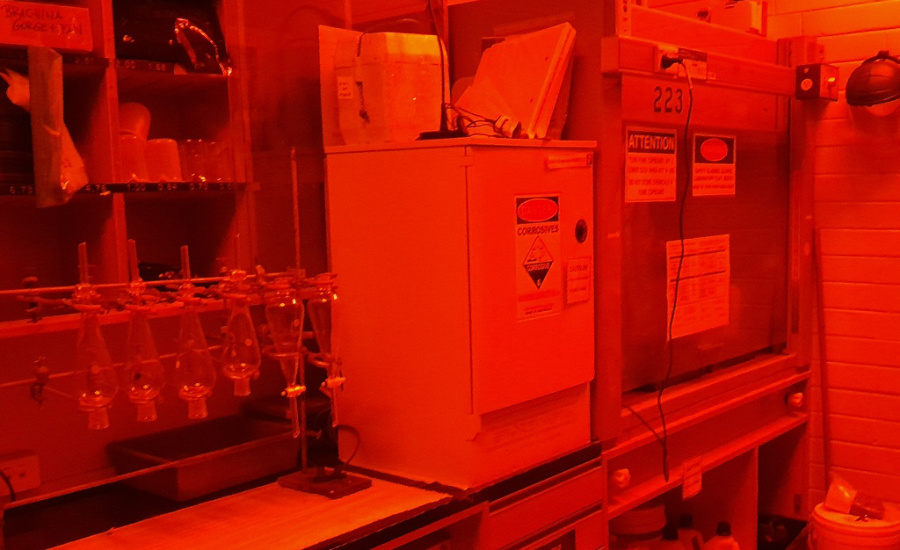
Prep lab in the luminescence dating facility.
Equipment
The facility has two fully equipped labs dedicated to sample preparation and instrumental analysis. It houses state-of-the-art equipment for the measurement of the luminescence signal.
- Sample-preparation facilities: sieving, ultrasonic baths, density separation (heavy liquid), fume hood for light chemical pre-treatment (HCl, H2O2), clean benches or cabinets under controlled red-light conditions.
- Drill-press for extracting rock cores for luminescence rock surface dating.
- Microscopy and imaging: stereo and compound microscopes, imaging systems for grain morphology and photo-documentation.
- Optical stimulation systems: 2x Risø TL/OSL readers (benchtop luminescence readers with infrared and blue/green stimulation sources and photon-counting detectors for low-noise signal acquisition.
- Single-grain attachment: 1x automated stages and disc systems for isolating and analysing individual sand grains of quartz or feldspar.
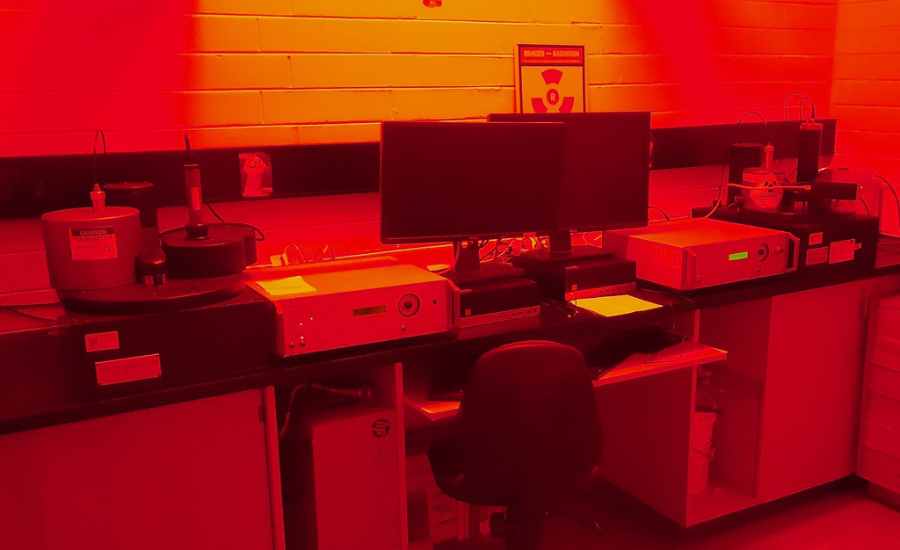
Machine lab in the luminescence dating facility.
Processing and analyses
The facility currently supports UoM and SGEAS staff and HDR students, higher degree research and teaching, and external collaborations across the globe. Processing and analytical steps include (but are not limited to):
- Induction to laboratory use and safety
- Sample handling and documentation: logging, photographic documentation, secure storage and light-safe sample preparation.
- Luminescence dating: single-grain and multi-grain OSL/IRSL dating, equivalent-dose determination, and age estimation with uncertainty quantification.
- Dose-rate characterisation through laboratory gamma spectrometry, in situ or laboratory sediment geochemistry to calculate environmental dose rates.
- Regular and routine instrument calibration, inter-laboratory comparisons and documented quality-assurance workflows.
- Complementary analyses: grain-size distribution, mineralogical identification, geochemical fingerprinting and provenance studies, often through collaborative arrangements.
- Data processing and interpretation: statistical analysis of dose distributions, age-modelling, stratigraphic correlation and integrated interpretation in geomorphological or archaeological contexts.
- Training and outreach: hands-on training courses, method workshops, and training for students or project teams.
- All activities follow established safety, regulatory and ethical standards.
Services and consultancy
The Luminescence Dating Facility has several decades of experience in offering consultancy for dating sediments from global contexts based on optically stimulated luminescence (OSL) dating. Depending on project needs, the consultancy service can include:
- Development of sampling strategy
- Geomorphological reconnaissance and interpretation
- Field support: advice on sampling strategies, light-safe coring/sampling or trench sampling protocols and trained personnel for supervised field sampling (logistics and safety dependent).
- Support with stratigraphic interpretation, documentation and sampling
- Luminescence screening at high-spatial resolution
- Multi- or single-grain luminescence dating on sand-sized quartz and feldspar
- Multi-grain dating luminescence dating on silt-sized quartz or polymineral separates
- Interpretation of results considering the geomorphological, archaeological and/or paleoenvironmental context
- Reporting and archiving: comprehensive technical reports, data packages, methodological documentation and long-term data archiving.
Get detailed guidance on sampling and dating approach, as well as price and turnaround time.
The total price and turnaround time is variable and depend on the nature and number of samples requested for dating, and lab capacity at the time.