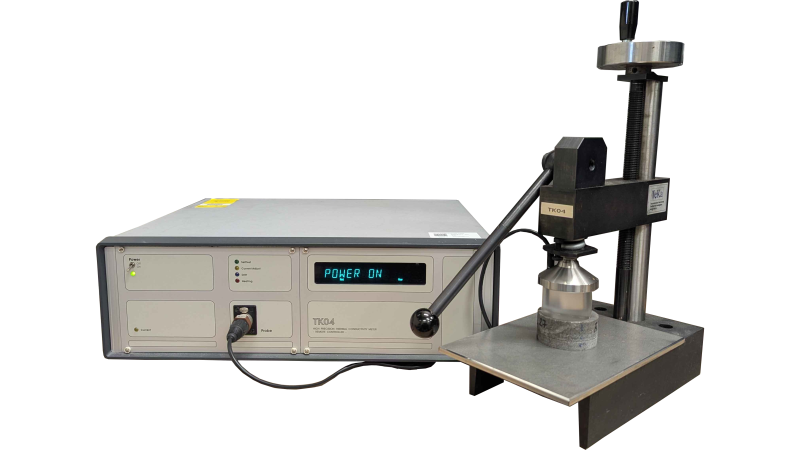
The TK04 thermal conductivity scanner by TeKa employs a number of different probes that all operate based on the transient line source method. The probe is heated with constant power and the sample temperature is recorded simultaneously. Conductivity is measured via the resulting heating curve (temperature vs time), producing an absolute value that does not require reference or calibration. Heating power can be adjusted to measure a range of conductivities (determined by the attached probe).
Needle probe: The device can be equipped with a needle probe to measure viscous materials (powders, pastes and liquids) or solid materials that have been very accurately drilled. This method requires a minimum sample diameter of 30mm and length of 75mm. It can measure conductivities between 0.1 and 10 W/mK +/- 2%.
Standard planar probe: The device can be equipped with an 88mm planar probe to measure flat solid materials. This method requires a minimum sample diameter of 80mm and height of 15mm. It can measure conductivities between 0.3 and 10 W/mK +/- 2%.
Mini planar probe: The device can be equipped with a 50mm planar probe to measure flat solid materials. This method requires a minimum sample diameter of 50mm and height of 15mm. It can measure conductivities between 0.3 and 3 W/mK +/- 5%.
The TK04 is housed at the University of Melbourne, primarily as a demonstration instrument.