Our research focuses on looking into the past through sediment archives, retrieved from wetlands, to uncover the legacy of Indigenous Care for Country across Australia.
We investigate changes in vegetation and fire over decades to thousands of years to reconstruct environments over time and highlight the integral role of people in ecosystems.
Our main research tools
We primarily use pollen (for vegetation), charcoal (for fire) and tree-rings (for forest demography) to investigate human-environment relationships and changes in past environments and climate.
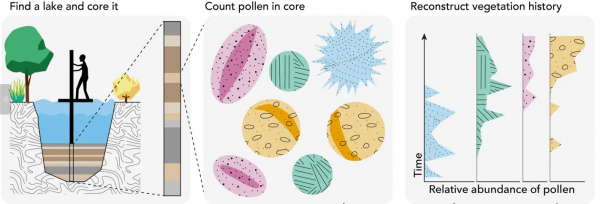
Vegetation (pollen)
Plants produce pollen that, thankfully for us, is unique in shape, texture and features. Pollen is transported primarily by wind (but also by insects, or other animals) that is then captured by wetlands and stored in their sediments. Counting the different types of pollen can tell us about vegetation changes over time.
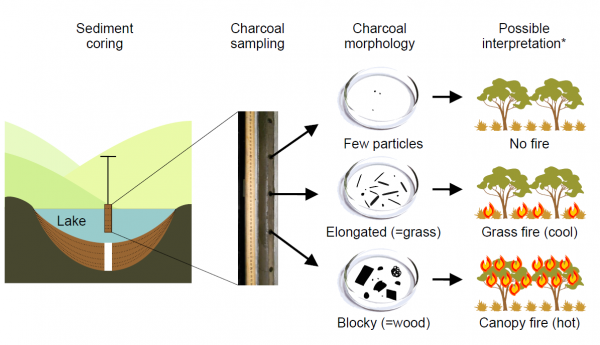
Fire (charcoal)
We use fossil charcoal stored in wetland sediments to look at past fire activity. No or few pieces of charcoal represent little to no fire whilst many pieces of charcoal represent lots of fire. The shape of charcoal can also tell us about the type of fire with long pieces representing cooler grass fires (e.g., cultural burning) whilst big, blocky pieces represent larger, hotter canopy fires (catastrophic fires).
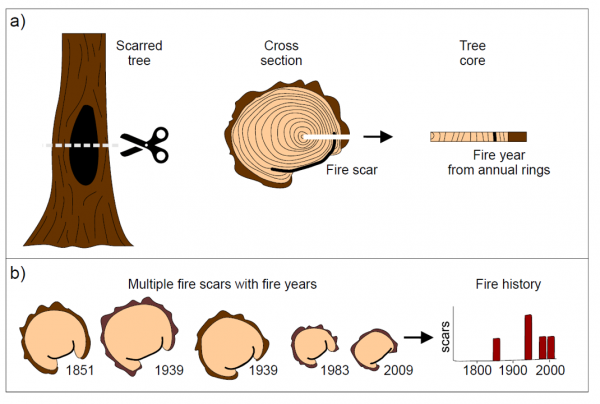
Tree-rings (dendrochronology)
We count tree rings to understand the age of forests, in particular rainforests in Tasmania. The more rings in a sample the older the tree is. Generally, we count backwards from the year the tree was cored to calculate its age.
Sediment coring on Mount Buffalo (Victoria)
Sediment coring in Lutruwita (Tasmania)
Sediment Coring Bolin Bolin Billabong (Bulleen, Naarm/Melbourne)
Graduate research
Are you interested in graduate research with our research group? Take a look at our current research projects and enquire with us about what we have available.
Our projects
-
Centre of Excellence for Indigenous and Environmental Histories and Futures
We directly address the urgent need to develop sophisticated data and models of the dynamics of past changes, including catastrophic change, to make Australia’s social-ecological future more certain and secure.
-
Traditional Owner-led restoration of urban billabongs
Demonstrating the importance and efficacy of TO-led wetland management and restoration using Melbourne’s degraded remnant riverine wetlands (billabongs) along the urbanised lower Yarra River (Birrarung).
Completed projects
-
Past Fire Frequency and Intensity REconstruction (PF-FIRE)
The austral summer of 2019/2020 saw the largest and most devastating bushfires in recorded history in Australia: the Black Summer Fires in southeast Australia. Australia is no stranger to fire, but have they always burned so hot?
-
Murnongs on Maar Country
Providing the foundation for a revitalisation of Murnong (Microseris spp./Yam Daisy) cultivation using a novel combination of history, historical and contemporary ecology, palaeoecology and Aboriginal cultural knowledge.